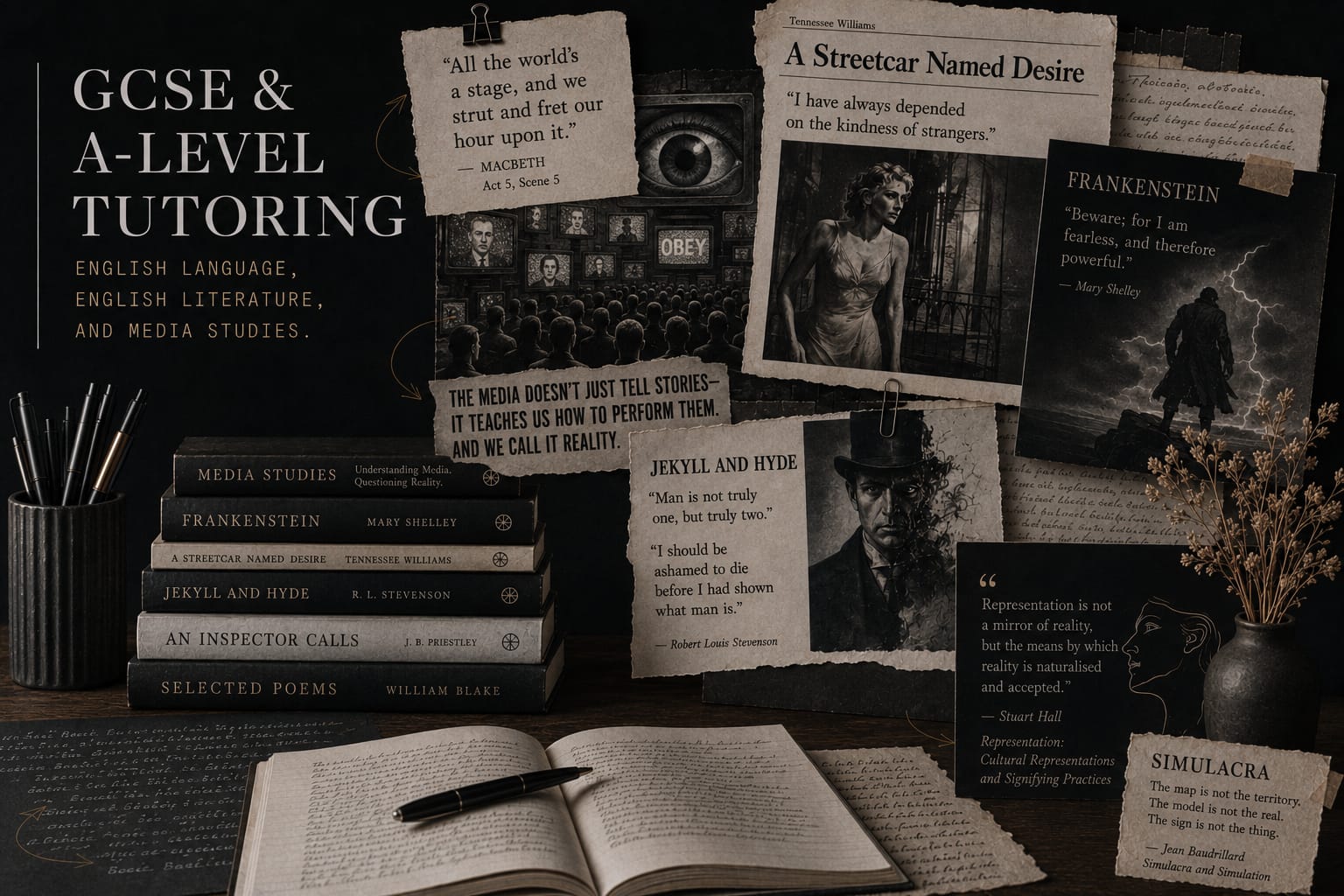
Most experience with AQA at GCSE, OCR at A Level, and Eduqas for Media Studies. All boards welcome; advance notice allows the specification, assessment objectives and set texts to be prepared properly.
English Literature
Fiction is never only characters in a story. It holds a mirror to the wider world, and offers a way of thinking about the human experience.
GCSE · AQA
Macbeth · Frankenstein · Lord of the Flies · Jekyll and Hyde · An Inspector Calls
A Level · OCR
A Streetcar Named Desire · Atonement · the poetry of William Blake · the poetry of Jacob Sam-La Rose
Other set texts are welcome, with notice, so the text can be studied properly before sessions begin.
English Language
Language does not merely describe; it builds. A social force that constructs identity, hierarchy and relationship, and shapes how we come to see and understand the world.
GCSE · AQA
Paper 1: Fiction Texts · Paper 2: Non-Fiction Texts
A Level · OCR
Non-Fiction Anthology · Language Change · Language Theory: Accommodation Theory, Grice’s Maxims, Speech Acts, and the gender models of Deficit, Dominance and Difference
Other exam boards are welcome, with notice to prepare the specification.
Media Studies
Meaning is constructed. Repeated representation hardens into ideology, and those ideologies are often shaped by industry, for power and for profit. Audiences are not passive: they may accept, negotiate or reject.
A Level · Eduqas
Marketing and Advertising · Music Video · Film · Magazines · Video Games · Radio and Podcast · Television · Online Media
Theory
Semiotics · Structuralism · Postmodern Theory and Simulacra · Cultivation Theory · Feminist Theory · Post-Colonial Theory
Other exam boards are welcome, with notice to prepare the specification.
International qualifications, including CXC, taken on after a conversation about the syllabus.
The English and Media Studies Tutor
Rochelle Kirkum‑Turnbull
BA (Hons) English Language and TEFLUndergraduate degree
PGCE in Secondary EnglishQualified teacher status
7+ yearsClassroom teacher & tutor
GCSE · A LevelInternational boards by arrangement
I have over seven years’ experience teaching English Language, English Literature and Media Studies at GCSE and A Level. My teaching rests on two convictions.
The first is curiosity. A student should care about what they study rather than endure it. Literature holds a mirror to human experience and asks what it is to be human. Language shows how words are a tool for constructing meaning, and with it identity, hierarchy and power. Media Studies presses further still: meaning is rarely found in a text, it is built into one, and repeated representation hardens into ideology about the world, which a student is then free to accept, negotiate or reject. Curiosity is what makes any of it worth the effort.
The second is the examination itself. Knowing the content is rarely the difficulty. Knowing what the question is asking for almost always is. My sessions work out the mechanics behind the paper: what a question is actually trying to tease out, and what the board wants a student to demonstrate in understanding and in skill. We unpick the wording of the question, read assessment objectives and mark schemes as instructions rather than jargon, and establish precisely what is being looked for. Answers are then built deliberately, rather than guessed at or repeated because “that’s what my teacher said”.
The Philosophy
“Nothing you read is neutral.”
A photograph is framed. A headline is chosen. A character is handed the words
that serve the play. Every text you meet was built: by a writer,
an editor, an industry, an ideology.
Most students are taught to remember what a text says. I teach them to see how it
was made. Once a student can read the decisions behind a text, it stops being
something to memorise and becomes something to argue with. And arguing with
it, precisely and in the examiner's own terms, is what the mark schemes reward.
The Fees
One hour, one student, undivided attention
All sessions run for a minimum of one hour, and longer where it is needed. One-to-one and entirely online. No contracts, no joining fee.
A Level
£40 / hour
GCSE
£30 / hour
Other qualifications
Price on request
Including CXC and other international boards, following a conversation about the syllabus.
The subject, the year group, the board if you know it, and what you are hoping to change. I will get back to you as soon as I can.
The Practicalities
Frequently Asked Questions
How do online sessions work?▼
Sessions run live on Microsoft Teams, or another platform if you would rather, such as Zoom. A meeting is set up and the link sent by email beforehand. Your child needs a device with a camera and a microphone.
Revision sheets and resources are shared through the chat on the platform, so there is a clear record of every session in one place. We also build a working document together in each lesson, so there is always something to revisit and revise from afterwards. It can be downloaded from the chat, or sent by email if you prefer.
Which year groups and curricula do you cover?▼
Years 9, 10, 11, 12 and 13. English support is also available to Years 7 and 8 where it is needed.
Most experience is with AQA at GCSE, OCR at A Level, and Eduqas for Media Studies. I am based in Trinidad, so CXC is covered as well.
All international qualifications can be taken on. I simply ask for enough notice to study the specification, the assessment objectives and any differences in set texts or exam requirements before we begin.
I'm not sure which option to choose. Do I have to commit?▼
Absolutely not. That's why we start with a free 15-minute intro call. No obligation, no pressure. We'll discuss what your child needs and I'll recommend the best fit. If tutoring isn't right, I'll tell you honestly.
What's included in a session?▼
Every session is tailored to current needs: essay planning, mark scheme breakdown, targeted reading comprehension practice, or creative-writing workshops. After the session you get a summary email with progress notes and homework tasks.
Do you provide materials?▼
Yes. Custom worksheets, past-paper strategies, and mark-scheme guidance tailored to your child's exam board. No generic PDFs; everything is prepared specifically for them.
What do lessons cost, and in what currency?▼
All prices are in pounds sterling. Sessions are £40 per hour at A Level and £30 per hour at GCSE, and run for a minimum of one hour. Other qualifications are priced on request. Payment is arranged by bank transfer.
One more step
Your email app should now be open with the details filled in. Press send to finish, and I will get back to you as soon as I can.